


AI Strategies and Business Intelligence for Executives

Program Overview

This Howard University AI Strategies and Business Intelligence Program for Executives is a premier five-week executive experience designed to elevate leaders beyond AI awareness into immediate application and enterprise execution. Delivered through a structured digital learning model that integrates self-paced modules and business case analysis, with live, faculty-led sessions, the program equips participants to embed AI into their daily leadership workflows—enhancing executive-level decision-making, productivity, and strategic impact.

Participants will develop the capabilities to identify high-value opportunities, build financially grounded AI strategies, and design operating models that scale across business units. The program culminates in a boardroom-ready AI strategy and execution plan, ensuring leaders leave prepared not only to understand AI—but to lead and deliver measurable results from it.

Who Should Attend

Senior leaders and high-performing managers responsible for strategy, innovation, and operational performance, including Senior Executives, Vice Presidents, Directors, government leaders, and entrepreneurs.


This foundational module provides an executive-level understanding of the evolution of artificial intelligence and its implications for leadership. Participants will learn to integrate AI into daily workflows to enhance productivity, analytical rigor, and decision-making.

What can students expect to learn from my course? 

  • Explain how AI evolved to its current capabilities, and why the last three years represented a step change.
  • Describe the use cases deployed today, including new opportunities brought by AI agents.
  • Frame an AI opportunity starting from the business outcome.
  • Analyze how one incumbent restructured and operationalized AI at scale.
  • Assess their own organization against chief success factors and the common pitfalls.


This foundational module provides an executive-level framework for turning AI investments into measurable business value. Participants will learn to identify high-impact AI opportunities, build AI-powered systems, and evaluate investments based on their potential financial and strategic impact.

What can students expect to learn from my course?

  •  Identify and prioritize high-impact AI opportunities based on business needs and potential value.
  • Design AI-powered systems that improve marketing, operations, and decision-making.
  • Develop an AI investment roadmap that connects technology decisions to measurable business outcomes.

Covers operating model design, talent alignment, and execution systems required to scale AI across functions and business units.

What can students expect to learn from my course?

  • In the five-day Scaling AI Across the Enterprise course, students learn how to move AI from isolated experiments to enterprise-wide capability.
  • They learn to assess organizational readiness, identify high-value AI opportunities, align people, processes, technology, and culture, and design responsible AI adoption strategies.
  • Students also explore how leadership, organizational intelligence, change management, governance, and human judgment determine whether AI creates sustainable value.
  • By the end of the course, students can develop a practical roadmap for scaling AI responsibly, strategically, and measurably across an organization.

Addresses governance, risk, and ethical considerations to ensure responsible AI deployment and executive oversight.

What can students expect to learn from my course?

  • Participants will learn how to evaluate and govern AI initiatives from an executive perspective – not simply by asking what the technology can do, but what the organization must have in place to use it responsibly and create sustainable value.
  • The course will examine AI governance, risk, organizational and human readiness, adoption, accountability, and executive decision-making.
  • Participants will leave with a practical framework for determining when an AI initiative should be piloted, modified, scaled, paused, or stopped – and how to explain the reasoning behind that decision. 

The final week focuses on the refinement and completion of a boardroom-ready AI strategy and execution plan. Participants receive expert guidance while leveraging dedicated team time to prepare and present their strategies to a panel of AI executives and scholars, gaining actionable insights and real-world implementation recommendations.


Instructors

Theodora

Professor Theodora Lau

Founder of Unconventional Ventures, keynote speaker, advisor, and one of American Banker’s Most Influential Women in FinTech. Author of Banking on Artificial Intelligence, co-author of The Metaverse Economy and Beyond Good, and host of One Vision, a podcast focused on fintech and innovation.

Johnny Graham, Ph.D

National Executive Director of the Howard University & PNC National Center for Entrepreneurship, a national hub advancing entrepreneurship at HBCUs. Dr. Graham is also a marketing professor at Howard University and co-founder of Our D.R.E.A.M. Foundation, supporting entrepreneurship education for Baltimore youth.
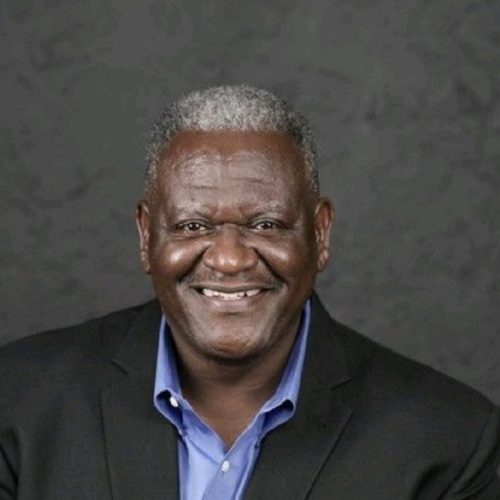
Terry

Terry Jackson, Ph.D

Creator of PTOD-OS™ and COO of JCG Consulting Group, Dr. Jackson is a PhD-level leadership and organizational change expert, executive coach, and author. A member of Marshall Goldsmith's 100 Coaches, he's advised leaders across healthcare, government, tech, and Fortune 500 companies.

Graham

Brian Hedgeman, JD, DrPH

A change management and AI enablement leader spanning law, public health, and consulting, Brian is a Senior Change Manager at Greenberg Traurig, guiding AI adoption across global legal operations.

Screenshot 2026-10-01 at 19.37.36

Kim R. Wells, MA, MCC

Executive Director in the Office of Executive Education at Howard University School of Business, leading executive and non-degree programs, including the EMBA, Global Executive Leadership Program, and Executive Coaching Certification Program. He also oversees career strategy, talent development, corporate recruitment, and corporate partnerships, developing leadership and training programs that connect academic expertise with organizational needs.

Screenshot 2026-10-01 at 19.37.47

Talitha Washington, Ph.D

Executive Director of the Center for Applied Data Science & Analytics (CADSA), Sean McCleese Endowed Chair, and Professor of Mathematics at Howard University. She also serves as Co-Chair of the President's AI Advisory Council, which guides the University's AI strategy across research, academic, and enterprise initiatives. Her work spans applied mathematics, dynamical systems, data science, artificial intelligence, and STEM education.

Program Value & Expected Outcomes

Participants will gain practical knowledge and tools to identify AI opportunities, make informed decisions, and translate AI strategies into meaningful business outcomes. The program will help participants:

  • Improve decision-making and operational efficiency through effective use of AI.
  • Align AI initiatives with organizational strategy and business priorities.
  • Build the skills and confidence to lead AI adoption and implementation.
  • Identify opportunities to automate, optimize, and enhance business processes.
  • Evaluate AI investments and measure their impact on business performance.
  • Develop scalable and responsible AI strategies that support long-term organizational growth.

Certificate

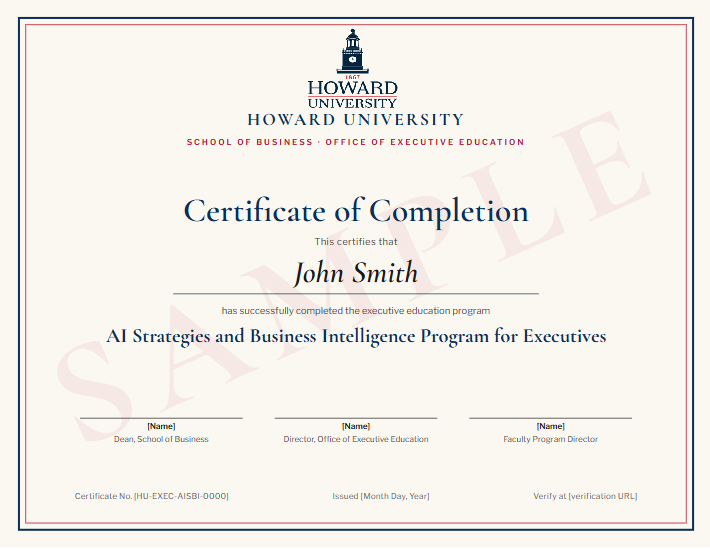
Participants who successfully complete the program will receive a Certificate of Program Completion from Howard University School of Business, Office of Executive Education.

Howard University’s Executive Education programs are designed to provide experienced professionals and leaders with practical knowledge, strategic frameworks, and tools that can be applied to real-world organizational challenges. Program components may include live instruction, pre-course readings, case studies, applied projects or capstone assignments, and follow-up implementation activities, depending on the program.

Upon successful completion of the program requirements, participants will receive their Howard University School of Business Executive Education certificate recognizing their participation and completion of the program.


Enrollment for this session has closed. If you are interested in future programs, please contact us at huexecutiveed@howard.edu.